Strait of Hormuz: British swimmer completes 15km crossing amid active war
Lewis Pugh witnessed attacks on commercial vessels during a three-day swim designed to draw attention to environmental damage in the conflict zone.
By Zainab Patel ·
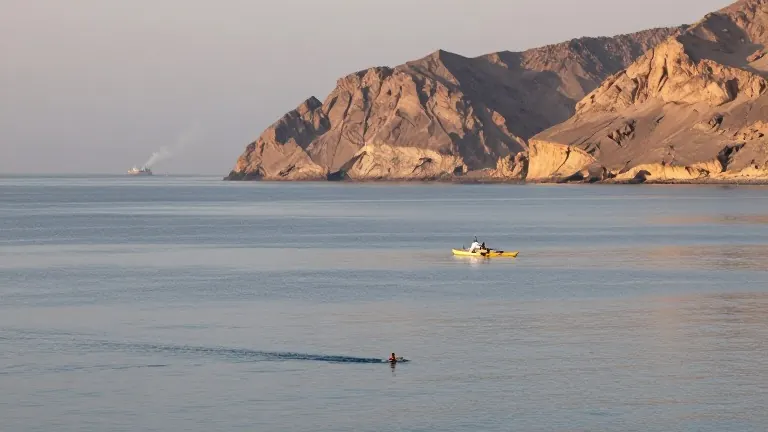
The Strait of Hormuz serves as a critical corridor for global oil transport and hosts diverse marine life. On November 22, 2026, British endurance swimmer Lewis Pugh completed a 9.3-mile (15km) swim across the waterway.
Pugh, a 56-year-old UN patron of the oceans, finished the three-day crossing from Musandam Island in Oman to the Cape of Hormuz. He is believed to be the first person to attempt a long-distance swim in this area since the conflict with Iran began in March. His route took him through the mountains and inlets of the Musandam peninsula and past Iran's mangrove forests.
During the swim, Pugh observed active military and commercial incidents. On the first day, an oil tanker was struck by a projectile roughly 2.5 miles from his position. On the second day, he saw flames rising above a headland where the liquefied petroleum gas carrier Tara Gas was burning. He later swam close to the vessel while it was still ablaze. He also witnessed fighter jets overhead and multiple attacks on other commercial ships.
"My immediate thoughts were for the seafarers onboard," Pugh said. "The flames were enormous. These vessels carry highly flammable gases, and an attack on one can have catastrophic consequences, not just for crew members but also on the surrounding marine environment."
Pugh stated that the swim was an effort to urge an end to the fighting and the reopening of the strait. He emphasized that environmental damage often receives less attention than the human cost of war. "War causes immense human suffering. Lives are lost, families are torn apart and homes, hospitals and schools can be destroyed in minutes. But there is another casualty that receives far too little attention: nature itself. And the damage can last long after the fighting has stopped," he said.
The UN reports that at least 175 vessels have been attacked since the conflict began, with about 30 of those incidents causing major pollution. The strait supports wildlife including dugongs, sea turtles, and whale sharks. Pugh noted that oil spills and contamination could harm coral reefs, seagrass meadows, and mangrove forests for the long term. A small expedition team, including a support boat and a kayak, remained alongside him during the swim.